Every Live Streaming Platform's VOD Policy in 2026
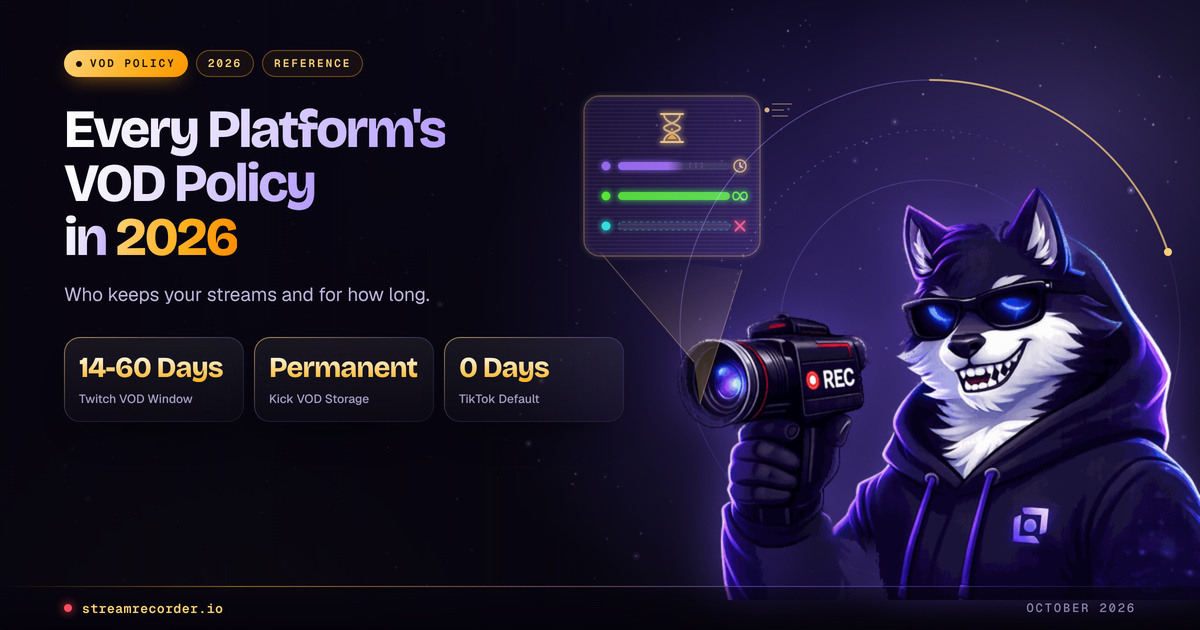
Every platform handles saved broadcasts differently, and the differences are bigger than most people realize. Some keep your streams for two months. Some keep them forever. Some keep nothing at all. And almost none of them let viewers download anything.
After a year of writing platform-by-platform recording guides, I've compiled the VOD and replay policies for every major streaming platform into one reference. If you've ever wondered how long you have before a stream disappears, or why you can't find a download button anywhere, this is the rundown.
One thing to note up front: VOD retention and download availability are two different things. A platform can keep a VOD for 60 days but still not let you download it. Throughout this guide, "retention" means how long the platform keeps the replay viewable, and "download" means whether viewers can save it to their device. On almost every platform, the answer to download is no.
Western Gaming Platforms
Twitch. VOD retention depends on account tier. Regular users get 7 days. Affiliates get 14 days. Partners, Prime, and Turbo users get 60 days. After that window, the VOD is deleted permanently unless the streamer converts it to a Highlight (kept indefinitely) or exports it. Viewers cannot download VODs. Only the streamer has download access, and stored VODs get muted if copyrighted audio is detected. Full detail in the Twitch VOD guide.
Kick. Replays last 7 days for non-verified channels and 30 days for verified channels. Verified channels can hold up to 30 replays at a time, non-verified up to 16. There's no permanent storage, no native viewer download button, and deleting a VOD cuts into the channel's own stats. Detail in the Kick download guide.
YouTube Live. The most forgiving major platform. Live streams are automatically archived as regular YouTube videos on the creator's channel, kept indefinitely unless the creator deletes them or sets them private. YouTube Premium subscribers can download videos within the app. The main risk is creator-side: deletion, privating, or copyright strikes. Detail in the YouTube Live guide.
Rumble. Inconsistent. Some live streams are automatically archived as permanent VODs on the creator's channel. Others aren't archived at all, depending on creator settings and the type of broadcast. No universal viewer download. Rumble Premium removes ads but isn't a download solution. Detail in the Rumble recording guide.
Mobile and Social Platforms
TikTok Live. The most ephemeral major platform. Nothing is saved by default. When a broadcast ends, it's gone unless the creator enabled "Save LIVE Replay" beforehand, and even then replays are temporary and subject to moderation. No viewer download exists. Detail in the TikTok recording guide.
Clapper. No viewer download. Replays are inconsistent and short-lived. Creators can save their own broadcasts to their device, but there's no permanent platform archive for viewers.
BuzzCast. No viewer download. Replays are inconsistent. Creators can save their own broadcasts locally, but not as a permanent platform archive.
Tlive. No viewer download and no meaningful replay archive. As a discovery-focused social streaming app, content is transient by design.
LiveMe. No viewer download. Built around live interaction with limited replay availability. The 450-million-user global platform keeps little for viewers to save.
Korean Platforms
SOOP (formerly AfreecaTV). Has a replay system, but retention is creator-controlled and full VOD access often requires Korean identity verification. No straightforward viewer download for international users. Detail in the SOOP/AfreecaTV guide.
CHZZK. Naver's platform has a replay system, but like other Korean platforms, it treats replays as secondary and access can require a verified account. No viewer download option.
Pandalive. Unpredictable is the word. Some replays stay up for 30 days, others disappear within 48 hours, with no published policy. No viewer download, and some content is age-gated behind Korean verification. Detail in the Pandalive guide.
FlexTV. Invite-only broadcasters, unpredictable and short replay windows, no viewer download. One of the most aggressively ephemeral platforms covered. Detail in the FlexTV guide.
Chinese Platforms
Douyin. Replays exist at the creator's discretion with no clear retention window. No viewer download. Chinese-language interface and registration barriers compound the access problem. Detail in the Douyin guide.
Bilibili. Archives some streams but access can be geo-restricted. No straightforward viewer download. Detail in the Bilibili guide.
Huya. Replays for some broadcasts at the streamer's discretion, no clear policy, no viewer download. Chinese-language and geographic barriers. Detail in the Huya guide.
Douyu. Same pattern as Huya: discretionary replays, no viewer download, plus regulatory pressure that can remove content quickly. Detail in the Douyu guide.
Japanese Platforms
Twitcasting. Broadcasters choose whether to archive as "shows." Replays are creator-controlled and can be deleted, password-protected, or never created. No native viewer download. Detail in the Twitcasting guide.
Mixch. Built around live events and auditions. Some archived content and background playback, but no viewer download and no robust archive for saving broadcasts. Detail in the Mixch guide.
The Pattern Across All Platforms
Look at that list and one thing jumps out: almost every platform, regardless of country or category, converges on the same two facts. Retention is limited or creator-controlled, and viewer downloads don't exist.
The exception that proves the rule is YouTube's indefinite archiving, notable precisely because it's unusual. Everyone else deletes on a timer (Twitch at 7 to 60 days, Kick at 7 to 30), saves nothing by default (TikTok), or leaves it entirely to creator discretion with short, unpredictable windows (most Korean, Chinese, Japanese, and social platforms).
And even the most generous platform doesn't let viewers download. YouTube's indefinite retention still doesn't give most viewers a download button. The content might stay available to watch, but keeping your own copy is a different matter that no major platform fully supports.
Why This Matters
The practical takeaway is simple. If there's live content you want to keep, you cannot rely on the platform to keep it for you. The retention policies range from generous to nonexistent, they can change, and creators can delete content regardless of platform policy. And no matter how long a platform keeps a replay, you generally can't download your own copy.
This is the entire reason external recording exists. When platforms won't reliably preserve content and won't let you download it, recording the broadcast yourself is the only way to guarantee you keep it. Cloud recording through StreamRecorder.io captures broadcasts across all the platforms in this guide, storing your own copy independent of each platform's retention policy. Whether the platform keeps the VOD for 60 days, forever, or not at all, your recording is yours.
Quick Reference Summary
For the fastest content-disappearance risk, worst to best: TikTok (nothing by default) and the social apps (BuzzCast, Clapper, Tlive, LiveMe) save the least. The Korean and Chinese platforms have short, unpredictable, or access-gated windows. Kick deletes on a 7-to-30-day timer, Twitch on a 7-to-60-day one. Rumble is inconsistent. YouTube is the most retention-friendly, keeping content indefinitely, though even it doesn't offer viewer downloads.
Wherever your content lives, the safest assumption is that the platform won't keep it as long as you want and won't let you download it. Record what matters.
For recording methods across every platform, start with the complete guide to recording live streams. For the tools, see Best Stream Recorders in 2026. Platform data lives at the StreamRecorder Research Hub.