The State of Live Streaming in 2026: Mid-Year Report
Six months into 2026, the live streaming industry looks meaningfully different than it did a year ago. The headline story is the erosion of Twitch's long-held dominance, but that's only part of it. The bigger picture is a market that has fragmented across platforms, content types, and continents in ways that make "the streaming industry" almost too broad a term to be useful.
I've spent the past year writing platform-by-platform recording guides for StreamRecorder, which means I've had a front-row seat to how many platforms actually matter now. A year ago, a streaming guide could cover Twitch, YouTube, and maybe Kick and call it comprehensive. Today that list runs to 18 platforms across North America, Korea, China, Japan, and the global social streaming space. Here's where things stand at the midpoint of 2026.
The Big Number: Market Redistribution
The single most important trend of the past 18 months is the redistribution of Twitch's market share.
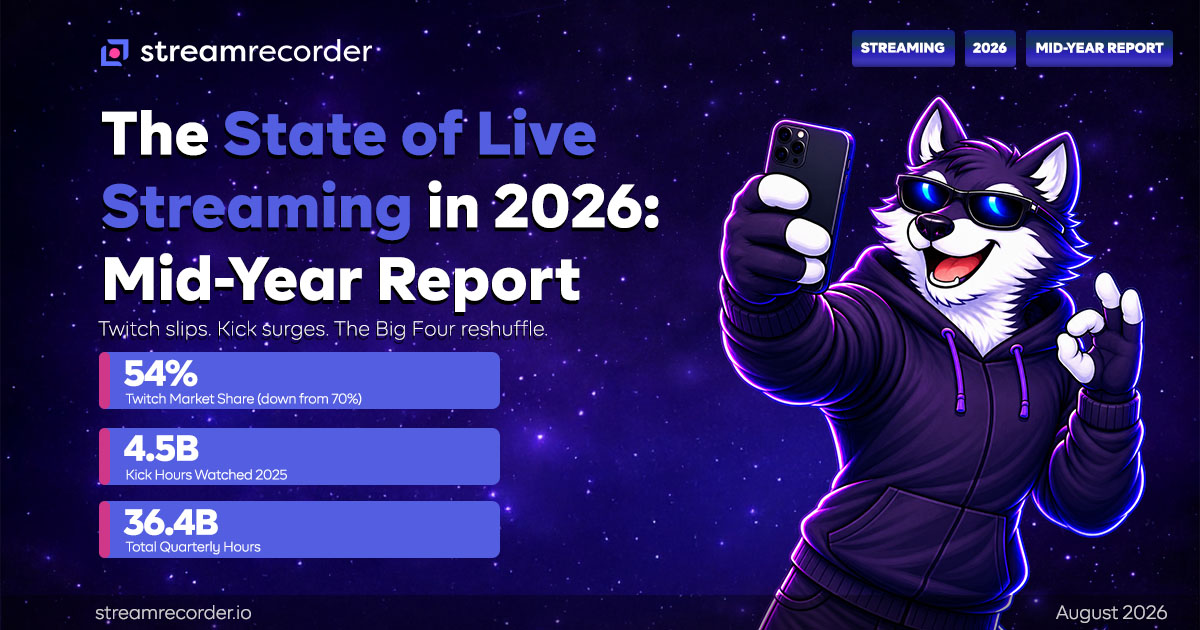
Twitch held roughly 70% of live streaming watch hours in 2024. By Q2 2025 that had fallen to 54% of the gaming market. That 16-point drop is the most significant market share loss in the platform's history. Twitch is still the largest gaming platform, still commands around 240 million monthly active users and 35 million daily, but the era of unchallenged dominance is over.
Where did that share go? Two directions.
YouTube Gaming absorbed a big chunk, climbing from about 17% to 24% of the gaming market. When you count all content types rather than just gaming, YouTube Live is now the overall leader, accounting for nearly half of all global livestreaming hours watched outside mainland China.
Kick took the rest and then some. Kick's growth has been the story of the past two years, surging to around 11% of the gaming market and 4.5 billion hours watched in 2025. Its aggressive 95/5 creator revenue split (versus Twitch's 50% for non-partners) has pulled established streamers off other platforms, and its permanent VOD storage with no expiration is a genuine differentiator.
The total gaming live streaming market generated 8.5 billion hours watched in Q2 2025 alone. The overall live streaming market reached around 36.4 billion hours for the year, growing roughly 6% year over year. The pie is growing, but Twitch's slice is shrinking within it.
The Four Markets, Not One
The most useful way to understand streaming in 2026 is to stop thinking of it as one market. It's four overlapping ones, each with its own dominant platforms and audience behaviors.
Gaming live. Twitch still leads here with 54% of gaming hours, followed by YouTube Gaming and Kick. This is the market everyone thinks of when they think of streaming, but it's no longer the whole story.
Social live. TikTok Live, and its Chinese counterpart Douyin, dominate here. In 2025 TikTok Live reportedly surpassed Twitch in total hours watched globally when including its massive Asian audience. This is casual, mobile-first, algorithm-driven live content, and it's the fastest-growing segment.
Commerce live. Live shopping is enormous, especially in Asia. China's live commerce GMV surpassed $688 billion, and platforms like Douyin, Taobao Live, and increasingly TikTok Shop have built entire economies around live selling. We covered this in depth in Live Commerce Recording.
Always-on and linear live. Newer entrants like Rumble are experimenting with linear, TV-style programming where shows flow into one another throughout the day. This is a different model entirely, closer to broadcast television than to on-demand streaming.
A platform can dominate one of these markets and be irrelevant in another. That's the defining feature of streaming in 2026.
The Regional Platforms Matter More Than Ever
A year ago, most Western streaming coverage treated Asian platforms as a footnote. That's no longer defensible.
Korea stabilized after Twitch's 2024 exit into a two-platform race between SOOP and CHZZK, both fighting for a market projected to hit $24 billion by 2035. We covered this fully in The State of Korean Live Streaming in 2026. Smaller Korean platforms like Pandalive and FlexTV serve dedicated niches.
China operates its own massive ecosystem behind the Great Firewall. Douyin dominates social and commerce live with 800+ million users. Huya (83.4M MAU) and Douyu (36.4M MAU) split the gaming market, both backed by Tencent. Bilibili serves the younger, anime-and-gaming audience.
Japan has Twitcasting, Mixch, and a strong VTuber ecosystem that increasingly drives global streaming culture. Japanese VTubers are among the most-watched creators worldwide.
Global social platforms like LiveMe (450M registered users) and BuzzCast connect creators across 190+ countries in a way that doesn't map neatly onto any single region.
For anyone trying to follow creators across these platforms, the fragmentation is a real problem. Different languages, different time zones, different VOD policies, different access barriers. It's the reason cloud recording across platforms has become genuinely useful rather than a niche convenience.
The VOD Retention Problem Got Worse
As the platform count exploded, so did the inconsistency in how long content stays available.
Twitch keeps VODs 7 to 60 days depending on account tier. Kick offers permanent VOD storage. TikTok saves nothing by default. YouTube auto-archives but creators can delete. The Korean and Chinese platforms mostly treat replays as optional and temporary. VTuber culture actively embraces unarchived streams that are designed to disappear.
The net effect is that in 2026, whether a given piece of live content survives its broadcast is close to random from a viewer's perspective. It depends on the platform, the creator's settings, the account tier, the content type, and sometimes regulatory pressure. We're publishing a full breakdown of every platform's VOD policy later this quarter, because the situation has genuinely become complex enough to require a reference guide.
What This Means Going Into H2 2026
A few things seem likely for the back half of the year.
Twitch's decline probably continues but slows. The platform is still enormous and still leads gaming. The freefall of the past 18 months looks more like a correction toward a competitive equilibrium than a collapse.
Kick keeps growing, driven by creator economics. The 95/5 split and permanent VODs are structural advantages that keep pulling creators over.
TikTok Live and the Asian social platforms keep expanding their share of total hours, even if Western gaming coverage undercounts them.
The platform count keeps rising. New entrants like Rumble, LiveMe, BuzzCast, and others keep carving out niches. The days of a three-platform streaming world are firmly over.
For viewers and creators, the practical takeaway is that no single platform is a safe bet for where content lives or how long it survives. The content you care about is increasingly spread across platforms that don't talk to each other and don't guarantee preservation.
For the full underlying data on market share, hours watched, and platform-by-platform breakdowns, see the streaming platform statistics page, which we update as new quarterly data comes in.
For platform-specific recording guides across every major service, start with the complete guide to recording live streams. See also The State of Korean Live Streaming in 2026 and Best Stream Recorders in 2026.