Live Commerce Recording: Why Sellers Need Stream Archives
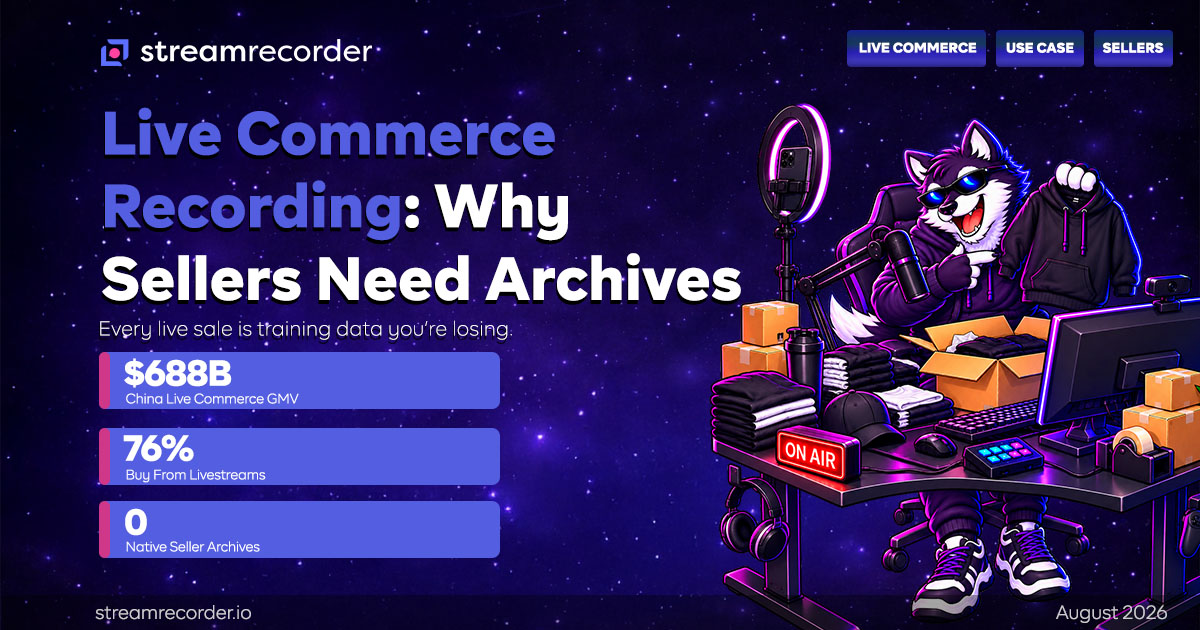
Here's a number that should stop any e-commerce operator in their tracks: China's live commerce GMV surpassed ¥5 trillion, roughly $688 billion, and is forecast to grow 20-25% annually through 2026. On TikTok Shop, 76% of consumers have bought something directly from a livestream.
Live selling is not a novelty anymore. It's a core retail channel moving hundreds of billions of dollars. And the overwhelming majority of these sessions are broadcast once, watched live, and then gone. The seller kept no recording. The performance that generated 5,000 orders in three hours exists nowhere.
That's a business problem, not just a content problem. Let me explain why every serious live seller should be recording their sessions, and how.
The Live Commerce Recording Gap
When a brand runs a live shopping session, an enormous amount of value is created and then discarded. The host demonstrates products, handles objections in real time, responds to comments, runs flash promotions, and converts viewers into buyers. Every one of those moments is data.
But the platforms where live commerce happens (TikTok Shop, Douyin, Taobao Live, Instagram, and others) treat the broadcast the same way they treat any other live stream. Some offer replays. Most have short retention windows. None give sellers a robust archive designed for business analysis.
So the session airs, generates revenue, and vanishes. The seller has the sales numbers but not the footage. They know they made $50,000 but they can't review exactly how they did it, what worked, what didn't, or how to train the next host to replicate it.
Why Sellers Need Their Live Commerce Recordings
1. Sales Team Training
The single most valuable use of a live commerce recording is training. A great live selling host has a specific skill set: product knowledge, timing, energy management across a multi-hour session, objection handling, and the ability to create urgency without sounding desperate.
When your best host runs a session that converts at 3x your average, that recording is a masterclass. New hosts can study exactly how the top performer handles the first ten minutes, transitions between products, responds to skeptical comments, and closes during flash promotions. Without a recording, that knowledge lives only in the host's head and disappears when they leave.
Brands running live commerce at scale need a library of their best sessions for onboarding and continuous improvement. That library only exists if someone recorded the sessions.
2. Competitive Intelligence
Recording competitor live commerce sessions is standard practice for serious operators. How does the market leader present a similar product? What price points do they hit? How do they structure their promotions? What's their host's energy and pacing? What objections do their viewers raise in the comments, and how does the host handle them?
This intelligence is available only during the live broadcast unless you record it. A competitor's session that moved significant volume is a strategic document. Recording it lets your team analyze it frame by frame, extract tactics, and adapt them.
Cloud recording is particularly useful here because it captures competitor sessions on platforms like Douyin (covered in our Douyin recording guide) where you might not have easy access, and it works across time zones for sessions happening in other markets.
3. Compliance and Quality Review
Live selling comes with regulatory exposure. In China, platforms are now required to enforce real-name verification, product authenticity, and rules against exaggerated claims. In other markets, consumer protection laws govern what sellers can and can't claim during a broadcast.
If a host makes a claim during a live session that later becomes a compliance issue, the recording is the record of what was actually said. Brands running live commerce need session archives for the same reason call centers record calls: quality assurance, dispute resolution, and regulatory compliance.
A seller who can't produce a recording of a session where a disputed claim was made is exposed. A seller with a complete archive can review exactly what happened.
4. Content Repurposing
A 3-hour live commerce session is a goldmine of short-form content. Product demonstrations, before-and-after reveals, customer testimonials read live, host reactions to popular products. Each of these can become a TikTok, a Reel, a YouTube Short, or an ad creative.
This is the same content repurposing workflow that entertainment streamers use, applied to commerce. The live session is raw material. The clips are the distributed output. But you can only clip what you recorded, and real-time clipping during a live sale is impossible when the host is focused on selling.
5. Performance Analysis
Which products got the strongest reaction? At what point in the session did viewership peak? When did the most orders come in? How did conversion correlate with specific host behaviors or promotional moments?
Sales data tells you what happened. The recording tells you why. Overlaying the sales timeline against the session footage reveals the exact moments that drove conversion. That analysis makes the next session better. Without the footage, you're guessing.
How to Record Live Commerce Sessions
Cloud Recording (Recommended for Sellers)
StreamRecorder.io supports the platforms where live commerce happens, including TikTok, Douyin, and other major streaming services. For recording your own sessions or monitoring competitors, cloud recording captures the full broadcast automatically on remote servers.
For your own sessions, this provides an independent, reliable archive that doesn't depend on the platform's replay policy or your team remembering to record locally. For competitor sessions, cloud recording monitors their channels and captures their broadcasts whenever they go live, across time zones and platforms.
Free tier covers 720p with up to three channels. For business use, paid plans offer higher quality and more channels, which matters when you're monitoring multiple competitors or archiving high volumes of your own sessions.
Local Recording (OBS)
If you're running your live commerce session from a desktop setup, OBS Studio can record your output locally at high quality while you broadcast. This gives you a pristine local copy with full encoding control. The tradeoff is that OBS requires your production computer to handle the recording load during the session, and local recordings are subject to the usual failure points (storage, crashes, power). Many operations run OBS local recording as the primary and cloud recording as the backup.
Platform Replays (Insufficient)
Relying on platform-native replays is a mistake for anyone serious about live commerce. Retention windows are short, replays can be pulled by the platform, and the replay quality and accessibility vary. Platform replays are fine for a casual viewer catching up. They're inadequate for a business that needs reliable, permanent, analyzable archives.
The Business Case
Live commerce sessions are expensive to produce. You're paying for the host, the production, the product samples, the promotion to drive viewership, and the platform fees. A single session can cost thousands of dollars to run and can generate tens of thousands in revenue.
Not recording that session is like running a focus group and throwing away the transcript. The event happened, value was created, and you kept none of the analyzable output.
For the cost of a recording setup (often free at the entry level, modest at the business level), sellers preserve an asset that improves training, sharpens competitive strategy, ensures compliance, fuels content, and drives performance analysis. The ROI on recording live commerce sessions is not close.
Bottom Line
Live commerce is a hundreds-of-billions-of-dollars channel, and most of the sessions that drive it are broadcast once and lost. For sellers, that's a strategic failure. Every live session is training material, competitive intelligence, a compliance record, a content library, and a performance dataset, all at once.
Record your sessions. Record your competitors' sessions. Build the archive. The sellers who treat live commerce as a repeatable, improvable system (rather than a series of one-time events) are the ones who compound their advantage over time. That system starts with keeping the footage.
For platform-specific recording guides relevant to live commerce, see our guides for TikTok Live and Douyin. For the content angle, see How Content Creators Repurpose Live Streams. Start with the complete guide to recording live streams. Platform data lives at the StreamRecorder Research Hub.