The State of Korean Live Streaming in 2026
Two years ago, Twitch pulled out of South Korea. At the time, Twitch was doing about 100 million hours watched per month in Korean-language content. That audience had to go somewhere.
Where it went tells you everything about how the Korean streaming market works in 2026 and why it matters to anyone recording streams from Korean platforms.
The Two-Platform Race
Korean live streaming in 2026 is dominated by two platforms: SOOP and CHZZK. Everything else is a niche player.
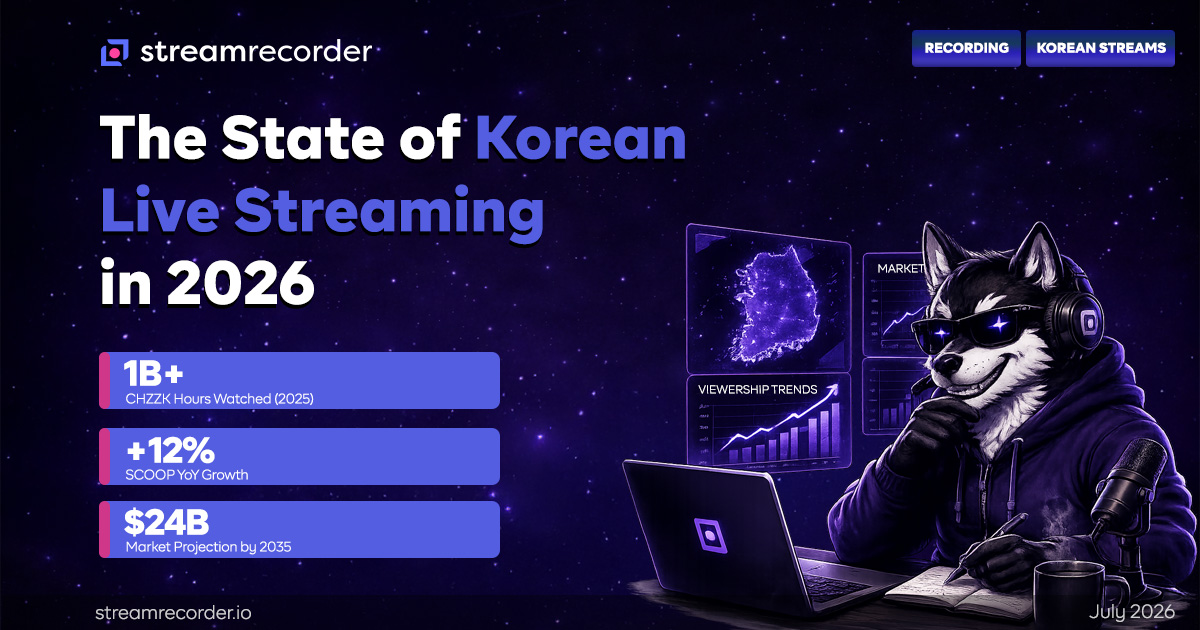
SOOP (formerly AfreecaTV) is the incumbent. The company rebranded from AfreecaTV in April 2024, splitting into SOOP Korea for domestic content and SOOP Global for international audiences. SOOP Korea is where the action is. The platform posted 12% year-over-year growth in hours watched through 2025, maintains tens of thousands of active channels monthly, and can pull over 500,000 concurrent viewers during major events.
SOOP's content mix skews toward social and IRL streaming more than its competitor. Just Chatting is the biggest category. League of Legends, StarCraft, and Minecraft dominate gaming. The platform has a strong Mukbang community (eating broadcasts, a format that originated in Korea) and a rapidly growing VTuber category that hit 10 million hours watched per month by the end of 2025.
The top SOOP streamers have been on the platform for years. Kim "phonics1" Min-kyo, Gamst, and Lee "철구형" Ye-jun all have roots in gaming and command loyal, highly engaged audiences. SOOP's creator ecosystem is built on relationships, not algorithms.
CHZZK is the challenger. Launched by Naver in December 2023, the platform was purpose-built to absorb Twitch's Korean audience after the shutdown. The strategy worked. CHZZK crossed 1 billion hours watched in 2025, growing 41% year over year. It now has more active channels than SOOP, though SOOP maintains a slight edge in total viewer count.
CHZZK's advantage is its integration with Naver's ecosystem. Naver is Korea's dominant search engine and web portal. That integration improves discoverability for streams and gives CHZZK a built-in distribution channel that SOOP can't match. The platform's UI is deliberately similar to Twitch, which made the migration frictionless for Korean Twitch users.
CHZZK skews more heavily toward gaming and esports than SOOP. League of Legends is the top category, followed by Minecraft, Overwatch, and social content. The platform set a peak concurrent viewer record of 538,000 in July 2025 during the League of Legends grand final at the Esports World Cup.
The gap is narrowing. In Q1 2026, the difference in hours watched between SOOP and CHZZK shrank by 10 million, down to just 57 million. CHZZK is catching up, driven by esports coverage (including the Winter Olympics) and League of Legends, where CHZZK is now winning the audience share battle against SOOP for LCK coverage.
What Happened After Twitch Left
The conventional wisdom was that Korean audiences would flood to SOOP and CHZZK, and the total market would recover quickly. That's half right.
SOOP and CHZZK did absorb most of Twitch's Korean audience. But the total Korean hours watched across all platforms dropped 16% from 2023 to 2024. Not everyone migrated. Some viewers, presumably the less committed ones, simply left the live streaming ecosystem when Twitch pulled out.
YouTube Gaming was expected to pick up more of the slack, given its dominance in other Asian markets like Japan and Thailand. That didn't happen. Korean audiences stayed loyal to locally operated platforms, choosing SOOP and CHZZK over YouTube's live offering. This is a pattern unique to Korea in the global streaming landscape.
By 2025, the market had stabilized. SOOP and CHZZK together recovered most of the lost viewership, and both platforms invested in features like AI-powered highlights, real-time translation, and improved creator tooling to deepen engagement rather than chase global expansion.
The Niche Platforms
Below SOOP and CHZZK, several smaller platforms serve specific Korean streaming niches. These don't show up in the global streaming charts, but they're relevant to anyone recording Korean content.
Pandalive (팬더티비) focuses on performance-oriented content, particularly the PandaClass dance format. It has a dedicated international following through TikTok clips and pulls about 17.6 million monthly visits according to Semrush. We covered it in detail in our Pandalive recording guide.
FlexTV (플렉스티비) operates an invite-only broadcaster model with curated, high-production content. Smaller and more exclusive than Pandalive. Our FlexTV recording guide covers the access challenges for international viewers.
PopkonTV occupies a similar niche. All three of these platforms share the Korean streaming philosophy: content is meant to be experienced live, replays are optional and temporary, and viewer downloads don't exist.
Why This Matters for Recording
The Korean streaming market has a unique relationship with content preservation that's fundamentally different from Western platforms.
On Twitch or YouTube, the assumption is that content should be available after the broadcast. VODs, highlights, clips, downloads. The platforms build tools to make past content accessible.
In Korea, the assumption is the opposite. Live content is live content. If you missed it, you missed it. SOOP and CHZZK both have replay systems, but they're secondary features, not core to the platform experience. Pandalive and FlexTV are even more aggressive about ephemerality, with short, unpredictable replay windows and zero download options.
This cultural approach to content preservation is why StreamRecorder.io supports three Korean platforms (SOOP/AfreecaTV, Pandalive, FlexTV) plus CHZZK. The recording demand from international viewers who discover Korean streamers through TikTok clips, esports coverage, or K-culture interest is significant and growing. These viewers want to follow Korean creators but can't be awake at Korean evening hours every night, and the platforms give them no tools to catch up.
Cloud recording bridges that gap. Add the Korean channels you follow, and every broadcast is captured automatically regardless of time zone or platform replay policies. For broader data on how these platforms compare globally, check the streaming platform statistics page.
What's Next
The SOOP vs CHZZK rivalry will define Korean streaming for the foreseeable future. CHZZK has momentum (41% growth, narrowing gap, stronger esports partnerships). SOOP has history, creator loyalty, and a more diversified content base. Neither shows signs of pulling away decisively.
The market itself is projected to reach $24.12 billion by 2035, growing at about 26% annually. Live commerce is a significant driver, as it is across all Asian streaming markets. AI features (automated highlights, translation, moderation) are being deployed by both platforms to improve creator and viewer experiences.
For international audiences, the most important trend is visibility. Korean streaming content is increasingly surfacing on TikTok, YouTube, and Twitter through clips and compilations. Each viral clip creates new fans who then need a way to follow the original creator on a Korean platform they've never used, in a language they don't read, in a time zone that doesn't work for them.
That's the recording use case in a nutshell. The content is worth watching. The platforms don't make it easy to keep. Cloud recording fills the gap.
For platform-specific recording guides, see our articles on Pandalive, FlexTV, SOOP/AfreecaTV, and Twitcasting. For the full recording method breakdown, start with the complete guide to recording live streams. Platform data lives at the StreamRecorder Research Hub.