How Sports Fans Use Stream Recording
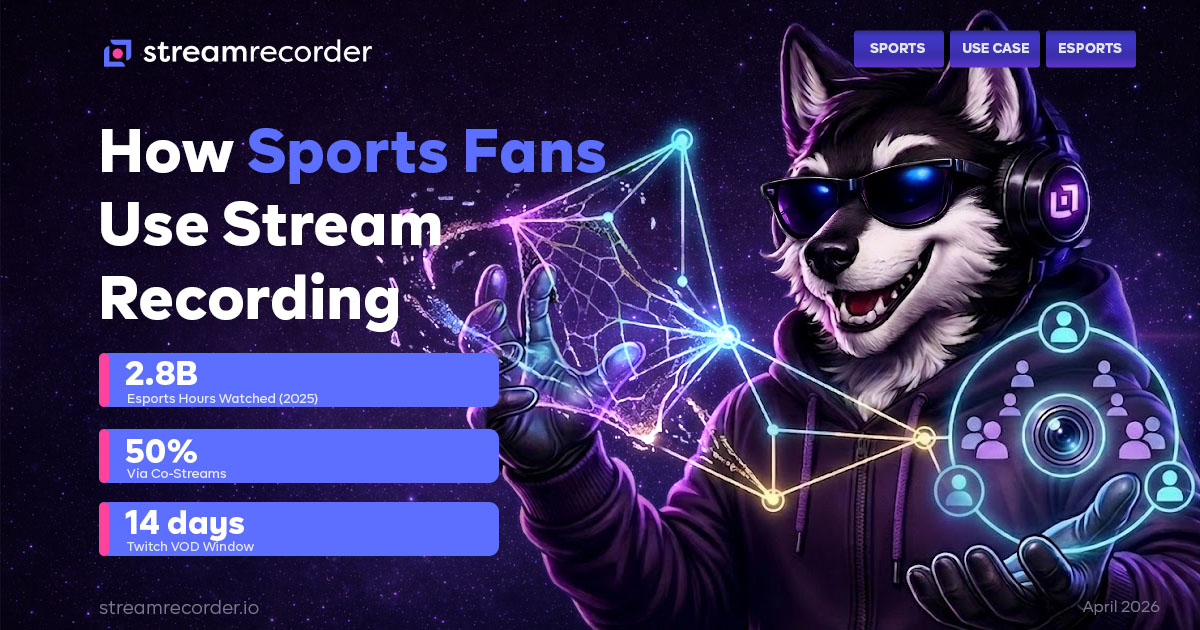
The League of Legends Worlds 2025 final hit 6.6 million peak concurrent viewers. By the time I checked the co-stream I actually wanted to watch three days later, the VOD was gone. Fourteen-day Twitch window. Expired on a Tuesday.
That's the thing about sports content on streaming platforms. The game itself usually gets archived somewhere official. But the stuff around the game, the reactions, the commentary, the co-streams with former pros breaking down every play in real time, that's where most of the value is for fans. And it's the first thing to disappear.
I started recording sports-related streams about eight months ago. Not official broadcasts (those have their own distribution). The creator layer on top. The watch parties, the analysis streams, the post-match breakdowns. The content that streaming platforms treat as disposable but fans treat as essential.
Here's how sports fans are actually using stream recording in 2026, and why the demand is growing faster than I expected.
The Co-Streaming Problem
Co-streaming changed how people watch esports. Half of all esports viewership in 2025 came through co-streams, not official channels. The numbers are wild. Caedrel alone pulled 83 million hours watched as a League of Legends co-streamer. Gorgc and NS dominated Dota 2's The International co-streaming. Kick broke into the top 10 for co-stream viewership for the first time.
The appeal is obvious. Official tournament broadcasts are polished but generic. A former pro co-streaming the same match gives you insider knowledge, real-time analysis, genuine emotional reactions, and community interaction that the official broadcast can't match. It's like watching a game with the most knowledgeable person you know, except that person played the game professionally for a decade.
The problem is that co-streams are creator content, not tournament content. They live on Twitch or Kick under the creator's channel, subject to the creator's VOD settings. Twitch Affiliates get 14 days of VOD storage. Partners get 60 days. Kick replays last 7 to 30 days. After that window closes, the co-stream is gone permanently.
Tournament organizers archive the official broadcast. Nobody archives the co-streams. And for a growing number of fans, the co-stream IS the viewing experience they actually want to revisit.
Five Ways Sports Fans Are Recording Streams
1. Preserving Co-Streams Before VODs Expire
This is the most common use case I've seen, and the one that originally got me into recording. A major tournament runs for two weeks. Your favorite co-streamer broadcasts 8-10 hours a day during the event. You watch some live, miss some because of work or time zones, and plan to catch up on VODs over the following week.
Then the VODs start disappearing. Fourteen days after the first broadcast, the early matches are gone. By day 20, half the tournament is missing. You're racing the clock to watch content that's actively being deleted.
Cloud recording solves this by capturing the co-stream the moment it goes live and storing it independently of the platform's VOD retention. StreamRecorder.io supports both Twitch and Kick, the two platforms where the vast majority of esports co-streaming happens. Set it to record the co-streamer's channel, and every broadcast gets captured automatically regardless of when it airs or how long the platform keeps it.
I recorded every Caedrel co-stream during Worlds 2025 this way. Still have them. Still rewatch specific games when I want analysis of a particular draft or teamfight.
2. Watch Party Recordings
Watch parties have expanded well beyond esports. Streamers on Twitch and Kick now run watch parties for UFC events, boxing matches, F1 races, and NBA playoff games. The streamer isn't broadcasting the event itself (rights issues prevent that), but they're reacting to it live with their community.
These watch party streams are some of the most entertaining content on Twitch. The reactions are genuine, the chat interaction is incredible during big moments, and the community energy during a knockout or a buzzer-beater is something you can't get from a highlights package.
But watch parties have the same VOD problem as co-streams, with an added complication: rights holders sometimes issue takedowns on watch party VODs even when the party didn't rebroadcast the actual event. Music in the background, incidental footage, or even just the audio from a TV playing in the room can trigger a DMCA claim that removes the VOD entirely.
Recording the stream as it airs means you have a copy that isn't subject to platform takedowns. Your recording exists independently of whatever happens to the VOD afterward.
3. Post-Match Analysis and Breakdowns
Some of the best sports content on Twitch and Kick isn't live during the match at all. It's the 2-3 hour analysis stream that happens afterward, where a knowledgeable streamer breaks down what happened, why it happened, and what it means going forward.
In esports, this is where you learn the most. A pro player reviewing the VOD of a Worlds match, pausing every 30 seconds to explain positioning, itemization, and decision-making, that's a masterclass that disappears in 14 days. In traditional sports, streamers break down game film, analyze trades, debate coaching decisions. The conversation is richer and more detailed than anything on ESPN.
These analysis streams are long. Often 3-4 hours. Most fans can't sit through them live. Cloud recording captures the full session, and you can watch it in chunks over the following days or weeks without worrying about the VOD timer ticking down.
4. Building Highlight Collections
This one is less about full recordings and more about the clipping workflow that starts with a recording. Sports moments on streams are inherently time-sensitive. A streamer's reaction to a game-winning play, a co-caster losing their mind during a pentakill, a watch party erupting when an underdog pulls the upset.
Short clips of these moments perform incredibly well on YouTube, TikTok, and Instagram. Fan accounts that compile the best reactions and commentary from co-streams build significant followings. But creating those compilations requires access to the full broadcast, and that means either clipping in real time (which means you catch maybe 20% of the good moments) or recording the full stream and editing afterward.
Having a complete recording lets you scrub through the entire broadcast after the fact, find the best moments, and clip them at your convenience. No rushing, no missed reactions, no panic-clipping when you think something might be good but aren't sure.
5. Time Zone Shifting
Sports don't care about your schedule. The Champions League final kicks off at a time that's convenient for European viewers but brutal for anyone in Asia or the Americas. Korean esports (LCK, the dominant League of Legends league) broadcasts during Korean evenings, which is early morning in the US and late night in Europe. UFC cards from Abu Dhabi or Perth start at hours that make no sense for North American fans.
The official broadcasts usually get archived. But the co-streams, watch parties, and analysis streams that make those events worth watching? Those follow the same VOD expiration rules as any other Twitch or Kick broadcast.
Recording the co-stream lets you watch it on your schedule. Wake up on Sunday morning and the recording of Saturday night's UFC watch party is waiting for you, complete with every reaction, every bad take, every "I told you so" moment after a surprising result.
Why This Is Growing
Three trends are converging.
Co-streaming is becoming the default viewing experience for esports. When half of all viewership comes through co-streams, and the official broadcast numbers are declining year over year, the co-stream isn't the side show anymore. It's the main event for a lot of fans. But the infrastructure hasn't caught up. Platforms still treat co-streams as regular creator content with the same short VOD windows.
Sports streaming rights are fragmenting. In the US alone, live sports are spread across ESPN (standalone since August 2025), YouTube TV, Peacock, Paramount+, Amazon Prime, Apple TV+, and the new FOX One app. Nobody has everything. Watch parties on Twitch and Kick have become a way for fans to experience events together that they can't all access through the same paid service.
Creator commentary adds value that official broadcasts don't. This has been true in esports for years but it's expanding into traditional sports. When a streamer with 50,000 viewers is breaking down a play with more insight than the TV commentators, and their audience is more engaged than any network's, the value proposition is clear. But that value only exists while the VOD is live.
Stream recording bridges the gap between the content fans actually want and the retention policies platforms enforce. For broader data on how viewership is shifting across these platforms, the streaming platform statistics page tracks hours watched, market share, and engagement patterns across Twitch, YouTube, Kick, and TikTok Live.
The Legal Reality
I want to be clear about what we're talking about and what we're not.
Recording a streamer's co-stream or watch party is the same legal territory as recording any other live broadcast on Twitch or Kick. The co-streamer holds copyright over their commentary and reaction. The underlying game or sporting event has its own rights holder. Recording for personal viewing sits in the same gray area as any other stream recording (we cover this in detail in the complete guide to recording live streams).
What you definitely should not do: re-upload someone's co-stream or watch party without permission. Especially watch parties that contain audio or footage from rights-protected sporting events. The combination of the streamer's content and the event's content creates a rights situation that nobody wants to test in court.
Record for personal viewing. If you want to share clips, keep them short and transformative. If you're building a fan account around co-stream highlights, get permission from the creators whose content you're featuring. Most streamers are happy to be clipped. Few are happy to have their full broadcasts re-uploaded.
Getting Started
If you're a sports fan who's been burned by expired VODs, the setup takes about two minutes.
Pick the co-streamers and sports commentators you follow. Add their channels in StreamRecorder.io. The service monitors Twitch, Kick, TikTok, and 8 other platforms. When they go live, recording starts automatically. When they stop, the recording is saved and ready for playback or download.
Free tier covers 720p with up to three channels. If you follow more co-streamers than that or want higher quality for fast-motion gaming content, paid plans go up to 4K. For most watch party and commentary content, 720p is plenty.
The next major tournament is always closer than you think. Set up recording before it starts, not two days in when you've already missed half the co-streams.
For recording guides for specific platforms, see our guides for Twitch, Kick, and TikTok. For platform-specific data on viewership and market share, visit the StreamRecorder Research Hub. This article is part of our complete guide to recording live streams.